
While you code
In your editor
VS Code, Cursor & Windsurf
Review the file you are writing - before you open a pull request.

Bitbucket integration is coming
Coming soonSame review, risk score, and suggested fix — landing on Bitbucket pull requests.
 GitHub live
 GitLab liveSee current setup →
Sign up free
Your team never leaves GitHub or GitLab. MergeGuard posts a score, the exact finding, and a suggested patch they can apply from the thread - plus the same review in VS Code while you write.
No credit card · 100 reviews/mo during your 14-day Pro trial
acme/checkout · Pull request #482
MergeGuard review
Posted on the pull request · just now
Merge risk
Medium42
/ 100
Auth change on the request path. One high finding should be fixed before merge.
Reply @mergeguards fix
Apply patchThis is what your team sees on the pull request — no extra dashboard.
0
Files reviewed
0
Bugs reported
0
Bugs fixed
Get started
No sales call. Connect GitHub or GitLab, open a PR, and your team sees the same kind of review.
Sign in with GitHub or GitLab
Use the account that owns your repos - no extra MergeGuard password.
Connect account →Pick the repos to review
Install the GitHub App or choose GitLab projects from your dashboard.
Setup guides →GitHub walkthrough · GitLab version
Same login. Same monthly quota. Catch it while you write, or on the PR.
While you code
VS Code, Cursor & Windsurf
Review the file you are writing - before you open a pull request.
Before you merge
GitHub & GitLab
Every PR gets a review, a risk score, and suggested fixes on the diff.
On the pull request
A real review on the diff: what is risky, why it matters, and how to fix it - before you install anything.
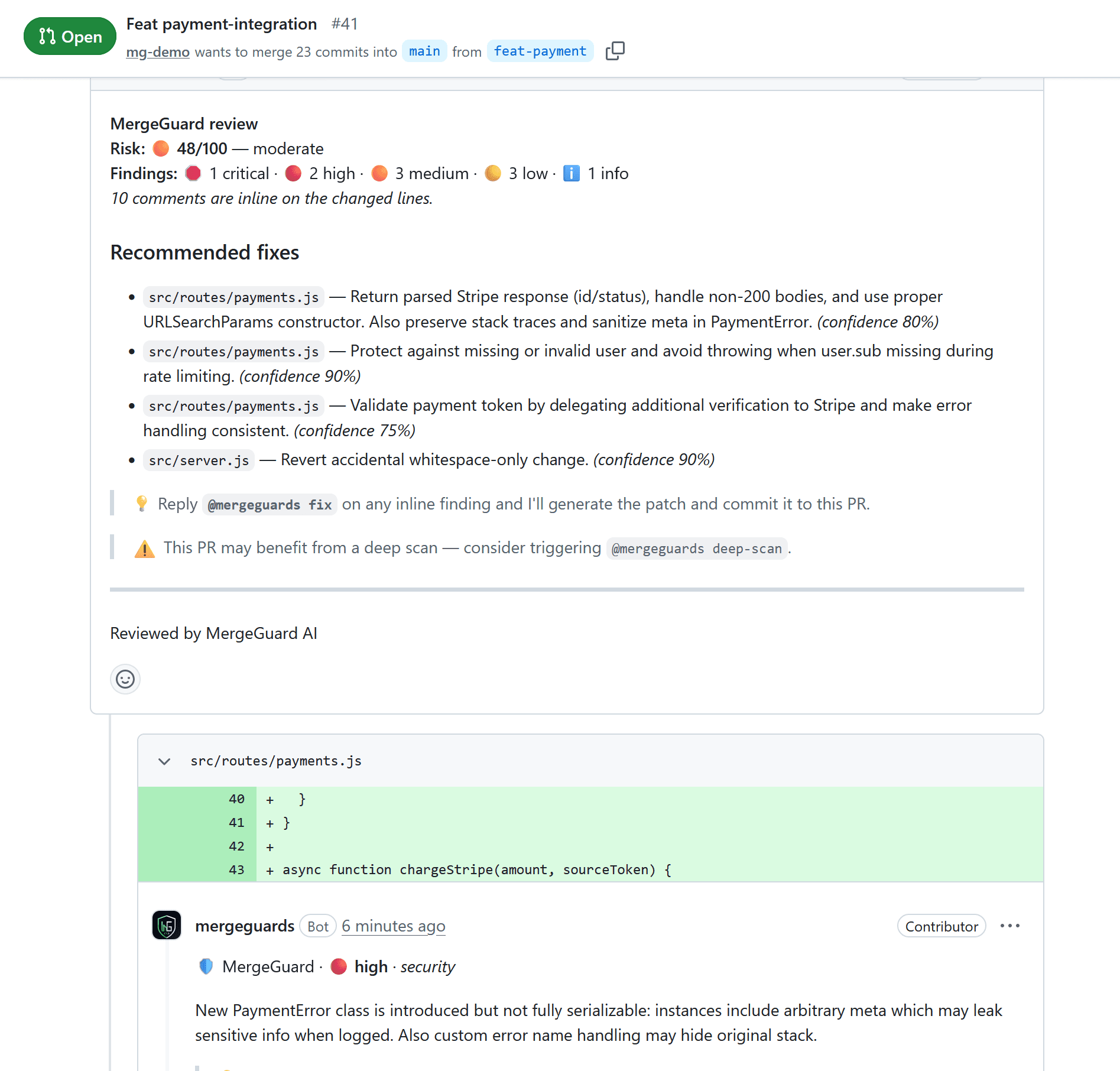
What you get
How it works
You never leave GitHub or GitLab. No extra dashboard.
01
Connect once. Every new or updated PR is reviewed automatically.
02
AI reads the diff while scanners check packages, secrets, and config.
03
A 0–100 score and findings land on the lines you already review.
04
Reply to apply a patch, run a deeper scan, or merge.
Need a follow-up? Reply on the same thread
Command reference →@mergeguards fixAll plansPatch a finding. The fix is committed to the pull request.
Included with the review
You don't buy a second scanner or stitch together extra AI tools. Vulnerable packages, leaked secrets, and container issues show up on the same pull request.
How security works →Scanning 6 targets in the diff
Findings
0
CVEs
0
Secrets
0
Misconfig
0
Code
Merge risk
merging findings…
OSV
Known CVEs in your lockfiles show up beside the rest of the review.
Powered by
 OpenAI
 AnthropicGitHubGitLab
 Railway
From teams using MergeGuard
It flagged a subtle async bug on a PR I was about to approve -the kind of thing we used to find in staging. Happy we have it on every pull request now.
Inline comments and @mergeguards fix save hours - I apply patches from the PR instead of hunting issues after merge.
MergeGuard caught a leaked env pattern and a vulnerable dependency in the same PR - both fixed before merge. Reviews feel consistent.
The risk score helps us focus on high-impact bugs first. Issues that used to slip through on busy review days get caught early.
Sign up free — 100 reviews for two weeks. No credit card.
Watch: MergeGuard in VS Code
Prefer to try it yourself? Install the editor extension · Setup guide
@mergeguard-followupPaidRe-run the review after new commits or discussion.
@mergeguards deep-scanPaidA heavier pass before merging a large change.
Trivy
Leaked credentials, risky Dockerfiles, and IaC issues in the same comment.
Container
When a PR changes a Dockerfile, the image scan follows - without delaying the review.
© 2026 MergeGuard. All rights reserved.
Built for GitHub and GitLab. Hosted on Railway. See security & infrastructure for detail.